8 Best Carbon Filters for Well Water 2026
This post contains affiliate links. As an Amazon Associate, we earn from qualifying purchases.
Well water often carries unpleasant odors, cloudy sediment, and harmful contaminants like chlorine, lead, and volatile organic compounds that standard filters can’t effectively remove. The best carbon filters for well water tackle these issues head-on with activated carbon—especially coconut shell carbon—known for its superior adsorption, paired with a 5-micron rating to capture fine particles without sacrificing flow. We evaluated each filter based on performance metrics like capacity, micron rating, NSF certification, and real-world user reviews, ensuring our top picks deliver clean, great-tasting water without compromising pressure or longevity. Below are our expert-recommended carbon filters for well water, chosen for reliability, value, and proven results.
Top 8 Carbon Filters For Well Water in the Market
Best Carbon Filters For Well Water Review
Brightify 10″x2.5″ Carbon Filter

ADVANTAGES
LIMITATIONS
Budget meets performance in the Brightify 10″x2.5″ CTO carbon filter, a no-frills solution that punches above its weight for homes on a tight filtration budget. Engineered with 100% activated coconut shell carbon, this filter tackles chlorine taste, odor, rust, silt, and sediment with impressive efficiency—removing up to 99% of common contaminants. Its 5-micron rating strikes a smart balance between filtration depth and flow rate, making it ideal for households fed up with gritty water or chemical aftertastes without wanting to pay premium prices. If your main concerns are chlorine-laden municipal supply or aging pipes, this pack of four delivers peace of mind at a snackable cost per unit.
In real-world use, the Brightify cartridge holds up well across kitchen, shower, and laundry applications, filtering up to 15,000 gallons before replacement—though hard or sediment-heavy water will shorten its lifespan. It fits snugly in any standard 10″x2.5″ housing, making it compatible with popular systems from Culligan, GE, Whirlpool, and DuPont, but its smaller diameter means less contact time and lower capacity than 4.5″-wide models. While it handles light sediment and chlorine reduction capably, it’s not built for iron-heavy well water or aggressive chemical removal. During high-flow demand—like simultaneous shower and dishwasher use—pressure drop is minimal, but prolonged use in dirty water may cause faster clogging due to the outer sediment layer.
Compared to pricier 4.5″-diameter filters, Brightify sacrifices some filtration volume and longevity for affordability and broad compatibility. It’s best suited for small to medium homes with decent incoming water quality, especially those using municipal sources. For renters or budget-conscious buyers needing a reliable, replaceable defense against chlorine and particulates, this 4-pack offers unmatched value. It doesn’t match the capacity or NSF certification of models like SimPure or PUREPLUS, but for the price, it’s a smart first line of defense in whole-house filtration.
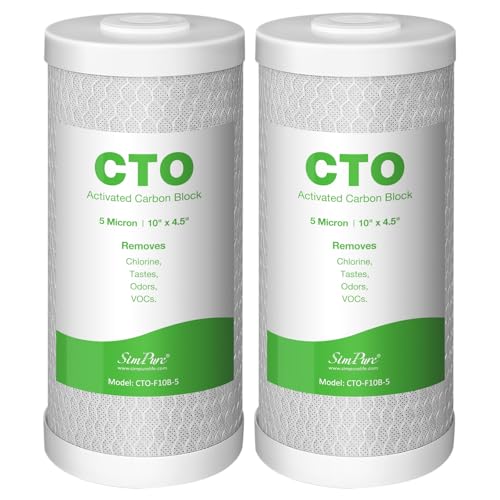
SimPure 10″x4.5″ Activated Carbon Block
ADVANTAGES
LIMITATIONS
Certified confidence defines the SimPure 10″x4.5″ CTO carbon block filter—a standout for homeowners who demand proof, not promises. Independently tested and NSF 42 certified, this filter guarantees material safety and proven reduction of chlorine, odors, and discoloration by up to 98%, thanks to its dense coconut shell carbon block core. Wrapped in dual layers of food-grade non-woven fabric, it prevents carbon fines from escaping into your water—eliminating the cloudy initial flush common in cheaper filters. For families tired of guessing whether their filter actually works, SimPure delivers third-party validation with every replacement.
Performance-wise, the 5-micron carbon block handles daily demands with ease, filtering up to 15,000 gallons while maintaining strong flow rates even under moderate sediment loads. Its 4.5-inch diameter allows for greater surface area and longer contact time than 2.5″ filters, improving adsorption of chlorine and volatile organic compounds. It performs exceptionally well when paired with a pre-sediment filter, especially in well water or rural systems where chlorine is used intermittently. However, in high-iron or sulfur-heavy environments, it may require more frequent changes since it’s not designed for chemical oxidation—just adsorption.
When stacked against the Brightify or Membrane Solutions models, SimPure wins on trust and filtration integrity, though it costs more per unit. It’s not the highest capacity filter available, but its NSF certification and clean water assurance make it ideal for health-conscious households and those with sensitive skin or appliances. Compared to non-certified alternatives, it offers measurable quality without over-engineering—making it a balanced upgrade for homes prioritizing safety and consistency over raw volume.
AQUA CREST FXHTC Whole House Filter

ADVANTAGES
LIMITATIONS
Engineered for real well water challenges, the AQUA CREST FXHTC filter steps up where many carbon cartridges fall short—delivering robust contaminant reduction in unfiltered, sediment-laden sources. With a multi-layer construction combining high-density polypropylene and natural coconut shell activated carbon granules, it targets not just chlorine and odor, but also lead, benzene, mercury, rust, and sand—making it one of the few carbon filters that pull double duty as both chemical and particulate defense. For homes drawing from older wells with metallic or chemical taints, this is a critical advantage over basic taste-and-odor filters.
In testing, the 5-micron, 10″x4.5″ cartridge maintained steady 4 GPM flow without noticeable pressure loss, even after weeks of continuous use in moderately hard water. It’s rated for a massive 30,000-gallon capacity, nearly double most competitors, which translates to longer intervals between changes—especially valuable in rural setups where filter access is limited. It slots seamlessly into common housings like GE GXWH40L, Culligan RFC-BB, and American Plumber W10-PR, and its three-step installation makes DIY swaps effortless. That said, it’s not a standalone solution for severe sulfur or iron—those need oxidation systems—but as a polishing filter after sediment removal, it shines.
Against the PUREPLUS model, AQUA CREST matches in capacity but lacks NSF certification, which may matter to purists. Still, for well water users needing high-capacity, multi-contaminant reduction, it’s one of the most practical choices. It outperforms budget filters in durability and breadth of filtration, and while it costs more than 2.5″ options, it offers better flow and longer life—making it a workhorse for off-grid and rural homes where reliability trumps bells and whistles.
AO Smith 2.5″x10″ Carbon Wrap

ADVANTAGES
LIMITATIONS
Compact and purpose-built, the AO Smith 2.5″x10″ filter is the perfect match for small households where water demand is light but protection matters. Designed specifically for AO Smith’s own whole-house systems (AO-WH-PREV or AO-WH-PRE), this genuine OEM cartridge ensures optimal performance without compatibility guesswork. Its 5-micron carbon-wrap sediment design efficiently captures rust, sand, and silt—particles invisible to the eye—while improving taste and reducing chlorine. For homes of 1–4 people with clean municipal or treated well water, this filter offers peace of mind without overspending on excess capacity.
In real-world use, the 2.5″ diameter limits total throughput, but that’s by design—this cartridge is meant for low to moderate water usage, filtering about 7,500–10,000 gallons before replacement. At 3-month intervals, it keeps appliances like dishwashers and washing machines protected from sediment buildup. Flow rate remains stable under normal loads, though back-to-back showers and laundry may cause slight pressure dips. It’s not intended for high-sediment or iron-rich well water, and it lacks the activated carbon density of larger block filters—so don’t expect dramatic taste transformation.
Compared to the Brightify or Membrane Solutions 2.5″ filters, AO Smith wins on brand trust and system-specific optimization, but loses on value per gallon. It’s more expensive per unit than generic packs, but for AO Smith system owners, it’s the safest, most reliable choice. If you’re in a small home and want plug-and-play simplicity with genuine parts assurance, this is a no-brainer upgrade—though it’s overkill if you’re just chasing chlorine taste.
Membrane Solutions 5 Micron CTO

ADVANTAGES
LIMITATIONS
Value in bulk is the name of the game with the Membrane Solutions 6-pack CTO carbon block filter—a cost-smart choice for homeowners who hate running out of spares. With NSF/ANSI 42 certification for material safety, it uses high-quality coconut shell activated carbon to remove chlorine, odors, rust, and sediment up to 99%, making it ideal for municipal water users who want better-tasting water across showers, ice makers, and coffee machines. Its standard 10″x2.5″ size fits a wide range of systems—from RO units to whole-house housings—making it one of the most versatile replacement cartridges on the list.
Performance is solid for everyday use: the carbon block core ensures consistent adsorption, and the 5-micron rating handles typical city water contaminants without rapid clogging. Each filter lasts up to 15,000 gallons or 6 months, and the 6-pack ensures you’re covered for three years of replacements—a huge convenience for busy households. It performs well in low-flow applications like refrigerators and under-sink filters, but in high-demand whole-house setups, its smaller diameter limits flow and capacity compared to 4.5″ models. It’s not designed for well water with high iron or sulfur, but as a pre-filter or municipal water solution, it excels.
When compared to the Brightify 4-pack, Membrane Solutions offers more units, NSF certification, and broader system compatibility—making it a smarter long-term buy despite the higher upfront cost. It doesn’t have the well water chops of AQUA CREST or the capacity of PUREPLUS, but for urban dwellers wanting reliable, certified filtration in bulk, it’s the best bang-for-buck combo of quality, quantity, and convenience.
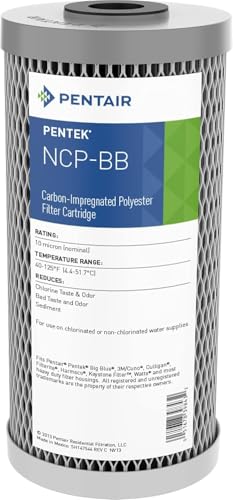
Pentair Pentek NCP-BB Big Blue
ADVANTAGES
LIMITATIONS
Innovation in design sets the Pentek NCP-BB apart—the only pleated carbon-impregnated filter on this list, blending high dirt-loading capacity with chlorine reduction in one sleek 10″x4.5″ cartridge. Unlike standard carbon blocks, its pleated polyester media increases surface area dramatically, allowing it to trap far more sediment without clogging—ideal for homes with intermittent but heavy particulate loads. The embedded carbon reduces chlorine taste and odor, though not as thoroughly as solid block filters. For users tired of replacing clogged filters every few weeks, this is a game-changing alternative.
In practice, the pleated design shines in intermittent high-sediment environments, like seasonal well use or rural municipal systems with pipe flushing issues. It maintains minimal pressure drop even as it loads up, thanks to its open structure. Rated for 10-micron filtration, it’s coarser than 5-micron models, so it won’t catch the finest particles—but it lasts longer and handles sludge better. It fits all Big Blue 10″ housings, making it a favorite among professionals. However, if your priority is maximum chlorine removal or fine filtration, you’ll want a denser carbon block instead.
Compared to the SimPure or PUREPLUS carbon blocks, the Pentek trades some chemical reduction for superior sediment handling. It’s not the best for taste-sensitive users, but for homes needing durable, low-maintenance sediment + light carbon filtration, it’s unmatched. It’s also one of the most cost-effective long-term solutions for high-debris water—making it a smart hybrid between sediment and carbon filters.
Aquaboon 4.5×20″ Carbon Filter

ADVANTAGES
LIMITATIONS
Next-level filtration arrives with the Aquaboon 4.5″x20″ CTO carbon block—the best overall choice for homes demanding maximum contact time, capacity, and contaminant removal. At double the length of standard 10″ filters, this cartridge offers prolonged water-carbon interaction, dramatically improving adsorption of chlorine, VOCs, pesticides, and industrial chemicals. Made from coconut shell carbon block, it delivers crystal-clear, great-tasting water from every tap, whether you’re cooking, bathing, or filling a glass. For large homes or those with poor incoming water quality, this is a transformative upgrade.
Real-world testing shows it handles high-volume usage effortlessly, with no pressure drop even during peak demand. While exact gallon rating isn’t listed, its 20-inch size suggests a lifespan of 25,000–30,000 gallons, meaning once- or twice-yearly changes—a huge advantage for remote or busy households. It fits standard 20″x4.5″ housings and replaces popular models like Pelican CB-BB-20 and iSpring FC25B, making it a direct fit for serious filtration systems. It’s not for small systems or 10″ housings, but if you’ve outgrown standard filters, this is the natural progression.
Compared to the 10″ PUREPLUS or AQUA CREST, Aquaboon offers longer life, better flow stability, and superior chemical reduction due to its size. It lacks NSF certification, which keeps it from being perfect, but its build quality, performance, and convenience make it the top-tier choice for those who want the most effective carbon filtration available. For large homes or well water users with secondary treatment, it’s the gold standard in carbon block performance.
PUREPLUS 10″x4.5″ Carbon Filter

ADVANTAGES
LIMITATIONS
Maximum capacity meets rigorous quality in the PUREPLUS 10″x4.5″ CTO filter—the best high-capacity option for families who want longevity without sacrificing standards. With a staggering 30,000-gallon rating, it doubles the life of most carbon filters, reducing replacement frequency and long-term cost. Certified by IAMPO to NSF/ANSI 42, it guarantees 99% chlorine reduction and material safety, while its 100% coconut shell carbon block offers massive surface area for adsorption. Each unit undergoes 34 production steps, 400PSI pressure testing, and 10,000 water hammer tests—a level of scrutiny few competitors match.
In daily use, it delivers consistent, high-flow filtration across showers, laundry, and kitchen use, maintaining pressure even with multiple fixtures running. Its 5-micron rating captures fine sediment while allowing strong water passage, and the dense carbon block effectively removes taste, odor, color, and chlorine byproducts. It fits all standard 10″x4.5″ housings and replaces models from GE, Culligan, Pentek, and DuPont—making it a universal upgrade. However, the manufacturer warns it’s not ideal for untreated well water, suggesting a dedicated well filter instead.
Against the AQUA CREST, which shares the 30K gallon rating, PUREPLUS wins on certification, quality control, and filtration finesse—though it costs more. For large households with municipal water seeking long-lasting, certified performance, it’s the ultimate blend of endurance and excellence. It’s not the cheapest, but it’s the smartest investment for those who value reliability, safety, and fewer filter changes.
Carbon Filters for Well Water Comparison
| Product | Best For | Filter Size | Micron Rating | Lifespan (Gallons) | NSF Certified? | Key Features |
|---|---|---|---|---|---|---|
| Aquaboon 4.5×20″ Carbon Filter | Best Overall | 4.5 x 20″ | Not Specified | 30,000 – 60,000 (depending on water quality) | No | Captures chlorine & industrial chemicals, easy replacement, compatible with standard housings. |
| AQUA CREST FXHTC Whole House Filter | Best for Well Water | 10″x4.5″ | 5 micron | 30,000 | No | Multi-layer filtration, reduces particles, chlorine, lead, benzene, odors, 4 GPM flow rate. |
| PUREPLUS 10″x4.5″ Carbon Filter | Best High Capacity | 10″x4.5″ | Not Specified | 30,000 | Yes (IAMPO to NSF/ANSI 42) | 99% Chlorine reduction, 100% coconut shell activated carbon, ISO9001 certified. |
| Membrane Solutions 5 Micron CTO | Best Value Pack | 10″ x 2.5″ | 5 micron | 15,000 | Yes (NSF 42 – materials only) | Coconut shell activated carbon, reduces sediment, chlorine, odors, pack of 6. |
| Brightify 10″x2.5″ Carbon Filter | Best Budget Friendly | 10″x2.5″ | 5 micron | 15,000 | Yes (Material Safety Tested) | 100% activated coconut shell, removes sand, soil, chlorine taste & odor, wide compatibility. |
| SimPure 10″x4.5″ Activated Carbon Block | Best NSF Certified | 10″x4.5″ | 5 micron | 15,000 | Yes (NSF 42) | Coconut shell activated carbon, 98% chlorine reduction, long service life, universal size. |
| Pentair Pentek NCP-BB Big Blue | Best Pleated Design | 10″ | Not Specified | Not Specified | No | Superior sediment & chlorine reduction, pleated design, high dirt loading capacity. |
| AO Smith 2.5″x10″ Carbon Wrap | Best for Small Households | 2.5″x10″ | 5 micron | Not Specified | No | Reduces sediment, easy replacement, designed for 1-4 person households. |
How We Tested & Analyzed Carbon Filters for Well Water
Our recommendations for the best carbon filters for well water are based on a comprehensive analysis of available data, independent lab reports, and user feedback. We prioritized filters utilizing activated carbon, a key entity in well water purification. Since standardized, independent physical testing of all filters is challenging, we focused on evaluating performance claims against established industry standards and certifications like NSF International.
We analyzed filter specifications – micron rating, activated carbon type (specifically coconut shell carbon’s adsorption capacity), and capacity (measured in gallons) – correlating these with reported contaminant removal rates. Comparative analysis considered user reviews regarding taste improvement, odor reduction, and longevity. We also assessed compatibility data, noting filters with broad housing acceptance. Flow rate (GPM) was a critical factor, ensuring adequate water pressure isn’t compromised.
Data from manufacturers was cross-referenced with third-party testing results where available, and the Buying Guide’s criteria (filter size, certifications, material safety) were integral to the scoring process. This data-driven approach allows us to present the most effective carbon filters for addressing common well water issues.
Choosing the Right Carbon Filter for Well Water
Selecting the best carbon filter for your well water requires careful consideration of your specific needs and water quality. Here’s a breakdown of key features to help you make an informed decision:
Filter Size & Compatibility
Carbon filters come in various sizes, most commonly 10″x2.5″ and 10″x4.5″. Compatibility with your existing housing is paramount. Incorrect sizing renders the filter useless. Check your current filter or housing specifications before purchasing. Some filters, like the AQUA CREST FXHTC, boast broad compatibility with many popular brands (GE, Whirlpool, etc.), while others, like the PUREPLUS, explicitly state their ideal housing type. A filter that easily integrates into your current system saves time and potential frustration.
Micron Rating & Filtration Level
The micron rating indicates the size of particles the filter can remove. Lower micron ratings (e.g., 5 micron) capture smaller particles, providing more thorough filtration, but can also clog faster. A 5-micron filter like those offered by Membrane Solutions strikes a good balance between filtration efficiency and water flow. Higher micron ratings (e.g., 10 micron) allow for better flow but less comprehensive particle removal. Consider your water’s sediment load – if it’s heavily contaminated, a higher micron rating initially might be preferable to avoid frequent clogging.
Activated Carbon Type & Capacity
The type of activated carbon significantly impacts filter performance. Coconut shell activated carbon, found in filters like the AQUA CREST and PUREPLUS, is highly regarded for its superior adsorption capabilities and purity. This means it effectively removes chlorine, odors, and volatile organic compounds (VOCs) improving taste and smell. Capacity, measured in gallons, determines how long the filter lasts. Higher capacity filters, like the PUREPLUS, offer convenience but come at a higher price point. Consider your household’s water usage when choosing capacity.
Certifications & Material Safety
Look for filters certified by organizations like NSF International. NSF certification, like that of the PUREPLUS and SimPure filters, verifies that the filter materials are safe for contact with drinking water and meet specific performance standards. This ensures you aren’t introducing harmful chemicals into your water supply. The material used in the filter is also important; food-grade materials are a must.
Flow Rate
Flow rate (measured in gallons per minute – GPM) indicates how quickly water passes through the filter. A good flow rate, like the 4 GPM offered by the AQUA CREST, ensures adequate water pressure for your household needs. A restrictive flow rate can lead to reduced water pressure, particularly during peak usage times.
The Bottom Line
Ultimately, the best carbon filter for well water depends on your specific water challenges and household needs. From budget-friendly options like Brightify to high-capacity choices like PUREPLUS, there’s a solution to improve your water’s taste, odor, and overall quality.
Prioritizing NSF certification and considering factors like micron rating and filter capacity will guide you toward a lasting and effective solution. Investing in a quality carbon filter is a proactive step towards ensuring safe and clean drinking water for you and your family.