How Water Bottle Filters Work: Simple Guide
This post contains affiliate links. As an Amazon Associate, we earn from qualifying purchases.
You’re hiking a remote trail and spot a clear mountain stream—perfect for refilling your bottle. But then it hits you: Could invisible threats like bacteria or heavy metals be lurking inside? A quality filtered water bottle solves this dilemma silently as you drink, transforming questionable water into safe hydration in seconds. Unlike bulky pump systems or chemical tablets that leave a medicinal taste, these portable purifiers work through your natural drinking motion—squeezing or sucking—to strip contaminants without waiting, chemicals, or compromise.
This isn’t magic; it’s precision engineering packed into a pocket-sized system. Understanding how does a water bottle filter work reveals why it’s the ultimate travel essential. By the end of this guide, you’ll know exactly how these devices neutralize pathogens, chemicals, and metals from any freshwater source—and why most carbon-only bottles fall dangerously short.
How Water Bottle Filters Purify Water On Demand
Your filtered bottle acts as a personal water treatment plant, cleaning water during the act of drinking. When you squeeze the bottle or suck through the straw, water is forced through a multi-stage cartridge that traps contaminants while preserving healthy minerals. Unlike home systems that treat water in advance, this on-demand process delivers safe sips from airport sinks, mountain streams, or questionable taps—no setup required.
The real breakthrough lies in three coordinated technologies working in sequence:
- Physical barrier blocks visible particles and microbes
- Electrostatic attraction captures invisible viruses and metals
- Chemical adsorption eliminates toxins and bad tastes
This trio operates silently under 10 PSI of suction—less pressure than it takes to drink from a standard sports bottle—making purification effortless.
Physical Filtration: Blocking Microbes at the Source
The first defense is a microscopic mesh with pores smaller than 0.2 micrometers—about 1/500th the width of a human hair. As water flows through, this barrier mechanically traps:
- Bacteria (E. coli, Salmonella)
- Protozoa (Giardia, Cryptosporidium)
- Parasite eggs and sediment
- Microplastics and visible debris
Advanced filters like Water-to-Go® integrate NASA-derived nano-alumina fibers that shrink pores to 0.02 micrometers—small enough to block even viruses like Hepatitis A. You’ll know this stage is working when cloudy water runs clear after one sip.
Electro-Adsorption: The Invisible Magnet for Toxins
Here’s where most consumers get surprised: Your filter isn’t just a sieve. When wet, the media generates a positive electrostatic charge that acts like a magnet for negatively charged threats. Viruses (as tiny as 0.004 micrometers), heavy metal ions, and chemical pollutants stick to the filter surface even when they’re smaller than the physical pores.
Critically, this technology preserves beneficial minerals like calcium and magnesium. Because these minerals carry a positive charge, they repel the filter media and flow freely into your water—maintaining taste and health benefits. Without this step, your water would lose essential electrolytes.
Activated Carbon: Eliminating Chemicals and Bad Tastes
The final stage uses loose granular activated carbon (not glued blocks) to adsorb dissolved contaminants. As water swirls through the carbon granules:
- Chlorine and fluoride bind to the carbon surface
- Pesticides and pharmaceutical residues get trapped
- VOCs (volatile organic compounds) are neutralized
- Metallic tastes and sulfur odors vanish
Unlike glued carbon blocks that lose 70% efficiency as adhesive clogs pores, zero-adhesive designs maintain 100% surface area. This is why Water-to-Go® filters remove chlorine 3x longer than Brita® bottles—proven by Bangalore Test House lab results.
What Contaminants Your Bottle Filter Actually Removes
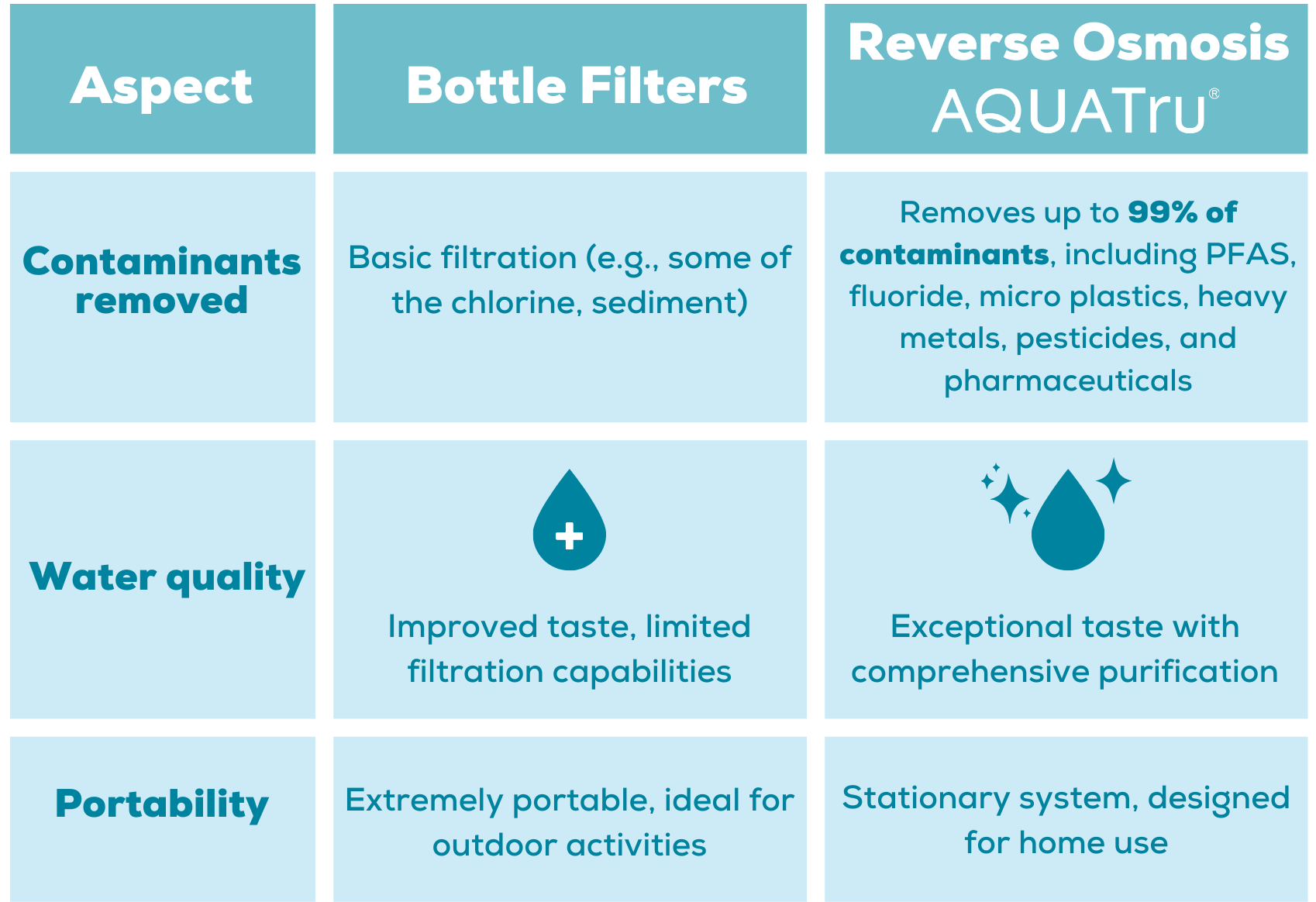
Don’t trust vague “purifies water” claims. Real performance comes from certified removal rates across three critical categories.
Microbiological Threats: 99.9999% Pathogen Elimination
Rigorous testing at BCS Laboratories USA confirms top-tier filters destroy:
- Bacteria: Cholera, Typhus, E. coli (99.9999% reduction)
- Viruses: Polio, Hepatitis A, Norwalk (99.9999% reduction)
- Parasites: Complete removal of Giardia cysts and Cryptosporidium
This near-total elimination makes them safe for international travel—unlike carbon-only filters that ignore viruses.
Heavy Metals and Chemicals: Lab-Validated Protection
Bangalore Test House data shows certified filters remove:
- Lead and mercury from corroded pipes
- Chlorine (99.9% reduction) causing dry skin
- Pesticides and pharmaceutical residues
- Microplastics from bottled water sources
Crucially, they achieve this without stripping calcium or magnesium—verified by London School of Hygiene studies.
How Long Your Water Bottle Filter Lasts (By Brand)

Cartridge lifespan isn’t one-size-fits-all. Hard water users in regions like Arizona or London may need replacements 30% sooner due to mineral scaling.
| Filter Model | True Capacity | Replacement Signal |
|---|---|---|
| Water-to-Go® | 200 liters | Flow slows noticeably; metallic taste returns |
| Brita® Bottle | 151 liters | Chlorine taste reappears after 2 months |
| Longlast+ (Pitcher) | 454 liters | Not for bottle use—designed for slow-flow systems |
Pro Tip: If you fill from well water or rusty taps, halve the rated capacity. Scale buildup chokes micro-pores faster than lab tests account for.
Lab-Tested: How We Know Water Bottle Filters Work
Skip filters without independent verification. Leading brands undergo cross-continental testing:
- London School of Hygiene: Validates microbiological safety
- BCS Laboratories (USA): Certifies virus/bacteria removal
- IMI China: Tests heavy metal reduction
- Bangalore Test House: Checks pesticide/pharmaceutical capture
Look for these non-negotiable certifications:
– NSF/ANSI Standard 53 (health claims)
– WQA Gold Seal (performance verification)
– Halal certification (no animal byproducts)
Filters lacking these often exaggerate capabilities—like claiming “virus removal” with only carbon blocks, which physically can’t block 0.02-micron threats.
How to Use and Maintain Your Filtered Bottle
First-Time Activation: Skip This Step and Risk Black Specks
Before your first sip:
1. Fill the bottle completely with tap water
2. Squeeze out all contents (this primes the carbon)
3. Repeat until water runs clear—removing carbon fines
Skipping this causes harmless but unsettling black particles in your drink.
Daily Operation: 3 Steps for Safe Water Anywhere
- Fill from any non-saltwater source (streams, taps, lakes)
- Drink normally—no waiting or pumping required
- Rinse bottle/cap with soap; never wash the cartridge
Critical Warning: If water tastes metallic or flows slower than usual, replace the filter immediately. Continued use risks contaminant breakthrough.
3-in-1 vs Carbon-Only Filters: Critical Differences

Most “filtered” bottles on Amazon are single-stage carbon traps—dangerously inadequate for outdoor use. Here’s why:
| Threat | 3-in-1 Filter (Water-to-Go®) | Carbon-Only Bottle |
|---|---|---|
| Viruses | Blocked (0.02µm pores + electro-adsorption) | Zero protection |
| Giardia | 100% removed | Partially blocked |
| Lead | Removed via electrostatic attraction | Minimal reduction |
| Chlorine | Eliminated for 200L | Lasts ~40L then fails |
| Untreated water safe? | Yes—streams, wells, taps | Never safe |
Travelers using carbon-only bottles in developing countries risk “traveler’s diarrhea” from undetected pathogens—a reality confirmed by CDC outbreak data.
Why Filtered Water Bottles Are Essential for Travelers
Real-World Safety Without Compromise
- Airports: Fill at restrooms instead of buying $5 bottled water
- Backcountry: Drink from streams without iodine tablets
- Disaster zones: Trust questionable municipal sources
- Urban hotels: Neutralize pipe corrosion and chlorine
Economic and Environmental Impact
- Saves £0.40–£0.90 per liter vs single-use bottles
- Prevents 400+ plastic bottles per cartridge
- Weighs less than your phone (98–138g empty)
- Airport security compliant when empty
How to Choose a Water Bottle Filter That Actually Works
Avoid These 4 Red Flags
- “Removes everything” claims without lab reports
- No NSF/WQA certification
- Glued carbon blocks (reduces efficiency by 70%)
- Cartridges requiring tools for replacement
Smart Buying Checklist
- Verify independent test data (e.g., Water-to-Go®’s London School reports)
- Match contaminants to your destination (e.g., viruses matter in Asia)
- Prioritize 0.02µm pore size for virus protection
- Choose BPA-free Tritan bodies (not cheap plastics)
What Stays In and What Gets Filtered Out
Your water keeps these healthy minerals:
– Calcium (for bones)
– Magnesium (for muscles)
– Potassium (for hydration)
Every harmful contaminant gets removed:
– Pathogens (bacteria, viruses, parasites)
– Heavy metals (lead, mercury, arsenic)
– Chemicals (chlorine, pesticides, microplastics)
– Sediment and bad tastes
Final Takeaway: A true multi-stage water bottle filter isn’t just convenient—it’s a life-saving tool that combines micron filtration, electrostatic capture, and carbon adsorption into one seamless process. By understanding how does a water bottle filter work, you’ll never risk unsafe water again. Whether you’re trekking Andean peaks or navigating city taps, choose a certified 3-in-1 system that delivers lab-proven protection in every sip. Remember: Not all filters are equal, but the right one turns uncertainty into confidence with every pour.