How to Replace Water Bottle Filter: Quick Guide
This post contains affiliate links. As an Amazon Associate, we earn from qualifying purchases.
That metallic taste in your filtered water isn’t in your head—it’s your exhausted filter silently failing. Water bottle filters don’t come with expiration dates stamped on the package. They die quietly after processing their last gallon, leaving you unprotected against chlorine, heavy metals, and bacteria. The average user replaces filters 40% later than needed, unknowingly drinking contaminated water. This guide delivers your precise replacement schedule based on actual usage—not arbitrary calendar dates—with brand-specific timelines and visual failure signs to watch for.
Filter Capacity Is Measured in Gallons, Not Months
Your water bottle filter functions like a microscopic sponge with limited absorption space. Once it processes its rated capacity—whether 25 gallons for Clearly Filtered or 1,000 gallons for LifeStraw’s membrane—it stops capturing contaminants and may even release trapped impurities back into your water. Time-based replacement myths (“change every 2 months”) only apply if you drink exactly the manufacturer’s assumed daily amount. A hiker refilling a 32 oz bottle three times daily will exhaust a filter in weeks, while an office worker using the same bottle once daily might stretch it to six months.
Brand-Specific Gallon Capacities
- Clearly Filtered: 25 gallons (95 liters)
- Brita Standard/Stream: 40 gallons (150 liters)
- LifeStraw Membrane: 1,000 gallons (4,000 liters)
- LifeStraw Carbon: 26 gallons (100 liters)
Calculate Your Exact Replacement Date
Use this formula: (Filter capacity ÷ ounces per fill) × 128 ÷ daily refills = days until replacement
Real-world example: With a 24 oz Brita bottle (0.19 gallons/fill) refilled twice daily:
(40 ÷ 24) × 128 ÷ 2 = 107 days (3.5 months)
Pro tip: Track refills using your phone’s Notes app with simple tally marks. One mark per fill—no math required.
Clearly Filtered Bottle Replacement Timelines

Your bottle size directly impacts filter lifespan since smaller bottles require more refills to reach the 25-gallon limit. Never rely on the “2-month” estimate printed on packaging—it’s dangerously inaccurate for heavy users.
32 oz Bottle Users: Refill Frequency Determines Everything
- One daily refill: Replace every 3–4 months (100 refills)
- Two daily refills: Replace every 1–2 months (50 refills)
- Three daily refills: Replace every 3–4 weeks (33 refills)
24 oz Bottle Owners: Adjust for Family Use
- One refill daily: 4–5 months (133 refills)
- Two refills daily: 1–3 months (67 refills)
- Shared by two people: Replace every 3–5 weeks
Critical mistake to avoid: Assuming all Clearly Filtered bottles share identical timelines. A 20 oz bottle with two daily refills lasts 2–3 months—nearly double the 32 oz bottle’s heavy-use schedule.
Brita Bottle Filter Replacement Reality Check
Brita’s “replace every 2 months” guideline applies only to users drinking one 24 oz bottle daily in soft water areas. Hard water or heavy usage slashes this timeline dramatically.
Standard vs. Stream Filters: Same Capacity, Different Risks
Both filter types handle 40 gallons, but Stream filters’ faster flow rate masks early failure signs. Hard water override: If your tap exceeds 120 ppm minerals (test with a $10 strip), replace filters every 30 days regardless of volume. Mineral scaling clogs filters 20% faster.
When Brita Filters Fail Early
- Cloudy filtered water: Indicates membrane rupture from sediment overload
- Chalky residue in bottle: Hard water minerals bypassing exhausted filter
- Sudden flow increase: Critical warning—filter media has channeling or cracks
Never ignore: A 30-second flow test. Time how long it takes to fill 8 oz. If it’s faster than when new, replace immediately—speed means contamination is getting through.
LifeStraw Go: Two Filters, Two Replacement Rules

LifeStraw’s dual-filter system requires separate tracking. Most users replace the carbon filter while the membrane still has years of life left.
Membrane Microfilter: The 1,000-Gallon Workhorse
This filter removes 99.9999% of bacteria and parasites for 12+ months of typical use. Replace only when flow stops completely—this indicates sediment blockage or biofilm growth. Never force water through; it damages the membrane.
Carbon Filter: Strict 2-Month Deadline
Despite its 26-gallon capacity, activated carbon degrades chemically over time. Replace every 60 days regardless of usage because:
– Chlorine removal drops 50% after 60 days
– Carbon becomes a bacterial breeding ground
– Metallic tastes return even with low usage
Emergency red flags:
❗ Sulfur (rotten egg) smell indicates bacterial colonization
❗ Visible black carbon particles in water
❗ Water temperature feels warmer than ambient (heat from microbial activity)
Visual Warning Signs Requiring Immediate Replacement
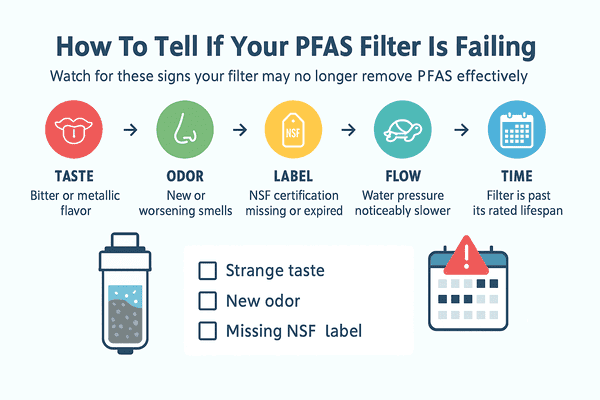
Your filter won’t send alerts—but it broadcasts failure through physical cues. These signs mean stop drinking immediately and replace the filter:
Critical Failure Indicators
- Cloudy or hazy filtered water: Particulates bypassing saturated media
- Metallic taste: Heavy metals (lead, copper) leaching through
- Sulfur odor: Bacterial growth in filter matrix
- Sudden flow increase: Media breakdown creating contamination channels
Debunking the Flow Rate Myth
Myth: “Slow flow means it’s time to replace.”
Reality: Many filters flow faster as they fail. The membrane develops cracks or channels, allowing unfiltered water to rush through. Flow rate alone never indicates filter health—always cross-check with taste and visual cues.
Hard Water Acceleration: When to Replace 20-40% Sooner

Mineral-rich water is the #1 cause of premature filter failure. If your tap water leaves white scale in kettles or showerheads, apply these adjustments:
Mineral Impact Scale
- 120–180 ppm hardness: Replace 20% sooner (e.g., Brita at 32 gallons instead of 40)
- 180+ ppm: Replace 30–40% sooner (Brita at 24–28 gallons)
- Visible scaling: Pre-filter through a coffee filter and replace immediately
Well Water Emergency Protocol
Untested well water demands double the replacement frequency until annual tests confirm safety. After heavy rains or flooding, replace filters immediately regardless of timeline—surface contaminants overwhelm filters rapidly.
Filter Maintenance Habits That Add 20% Lifespan
Extend your filter’s life with these science-backed practices:
Daily Non-Negotiables
- Empty bottle nightly: Stagnant water breeds biofilm in 48 hours
- Rinse mouthpiece with vinegar: Prevents bacterial growth at contact points
- Air-dry inverted: Stops moisture-trapped bacterial colonies
Storage Secrets
- Short trips (1–7 days): Refrigerate filled bottle to slow bacterial growth
- Vacation prep (1+ weeks): Remove filter, seal in zip bag with damp paper towel, refrigerate
- Never freeze: Ice crystals permanently rupture filtration media
Critical error: Using hot water (>100°F). It melts binding agents in carbon filters, creating dangerous bypass channels.
Quick-Reference Replacement Matrix
| Brand | Filter Type | Gallon Capacity | Time Guide* | Hard Water Adjustment |
|---|---|---|---|---|
| Clearly Filtered | Advanced composite | 25 gal | 3–6 mo | 20% sooner |
| Brita | Standard/Stream | 40 gal | 2 mo | Monthly replacement |
| LifeStraw Go | Membrane microfilter | 1,000 gal | 12+ mo | Flow-based only |
| LifeStraw Go | Activated carbon | 26 gal | 2 mo | Time-based (no adjustment) |
*Time guide assumes 1 daily refill of standard 24 oz bottle. Adjust for actual usage.
Emergency Replacement Triggers
Replace filters immediately if any occur:
– Filtered visibly dirty or cloudy source water
– You’ve been sick (filters harbor pathogens during illness)
– Bottle sat with water inside >72 hours
– Dropped bottle from waist height or higher (impact cracks media)
Pro tip: Keep one spare filter in your car’s glove compartment. Emergencies happen when you’re miles from home.
Subscription Tracking vs. Manual Methods
Auto-delivery services (Brita, Clearly Filtered) calculate shipments based on your bottle size and usage frequency, typically saving 10%. They’re ideal for forgetful users but over-order if your routine changes.
DIY tracking that works:
1. Write install date with permanent marker on bottle base
2. Set phone reminder at 80% of calculated timeline (e.g., 80 days for 100-day filter)
3. Use a $2 bottle tracker sticker (available on Amazon) with sliding date window
Never skip: The 80% check-in. Most filters fail between 85–95% capacity—you’ll catch decline before health risks.
Your water bottle filter’s expiration date is written in gallons, not days. Track actual refills, watch for metallic tastes or cloudy water, and replace carbon filters every 60 days regardless of usage. A $12 filter replacement prevents $500+ medical bills from waterborne illness. Right now, grab your bottle and mark today’s date on it—your future hydrated self will thank you. For hard water users, test your ppm with a $10 strip and adjust timelines immediately. When in doubt, replace early; your health depends on what you can’t taste.